I’ve seen amazing posts about close reading all over my Bloglovin’ feed. Phenomenal educators are sharing best practices, resources, and personal opinions about close reading in posts like this, this, and this. I’ve even dabbled {here} in the topic too. While I am no expert, I love sharing what I know and hearing the opinions of others. This post will focus on the actions that teachers can take before and during a close reading lesson with students. It is my personal philosophy that teachers should engage with the text at least four times before the lesson:
1) For fun
2) To determine the literal meaning
3) To focus on the author’s craft
4) To identity places where students might be confused
These steps are important because teachers need to be experts on the text before expecting students to be experts on it.
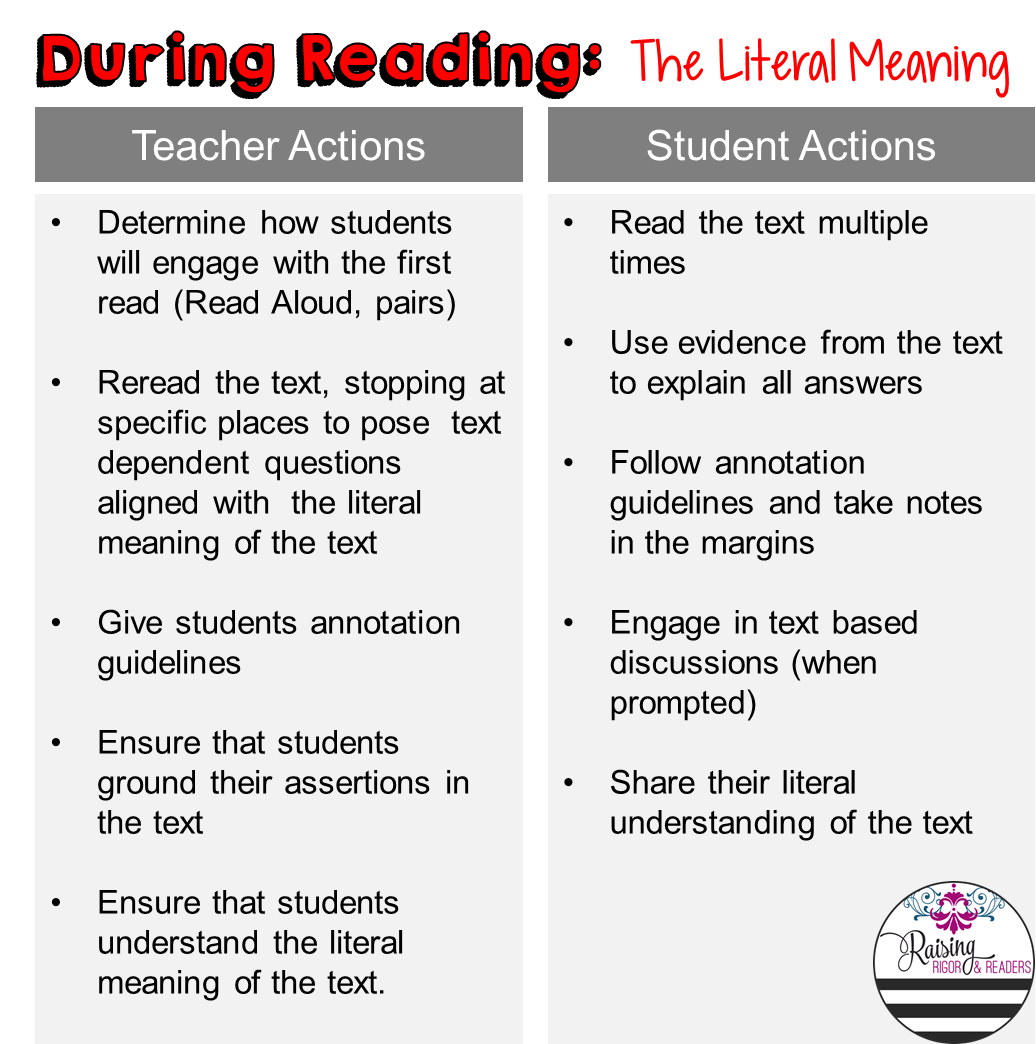
Below is a non-exhaustive list of teacher and student actions that assist students with grasping the literal meaning of the text. Please note that many scholars and educators refer to this as “Key Ideas and Details” which aligns to the Common Core Standards. For the sake of brevity, I call this literal comprehension where students identify the big idea of the text.
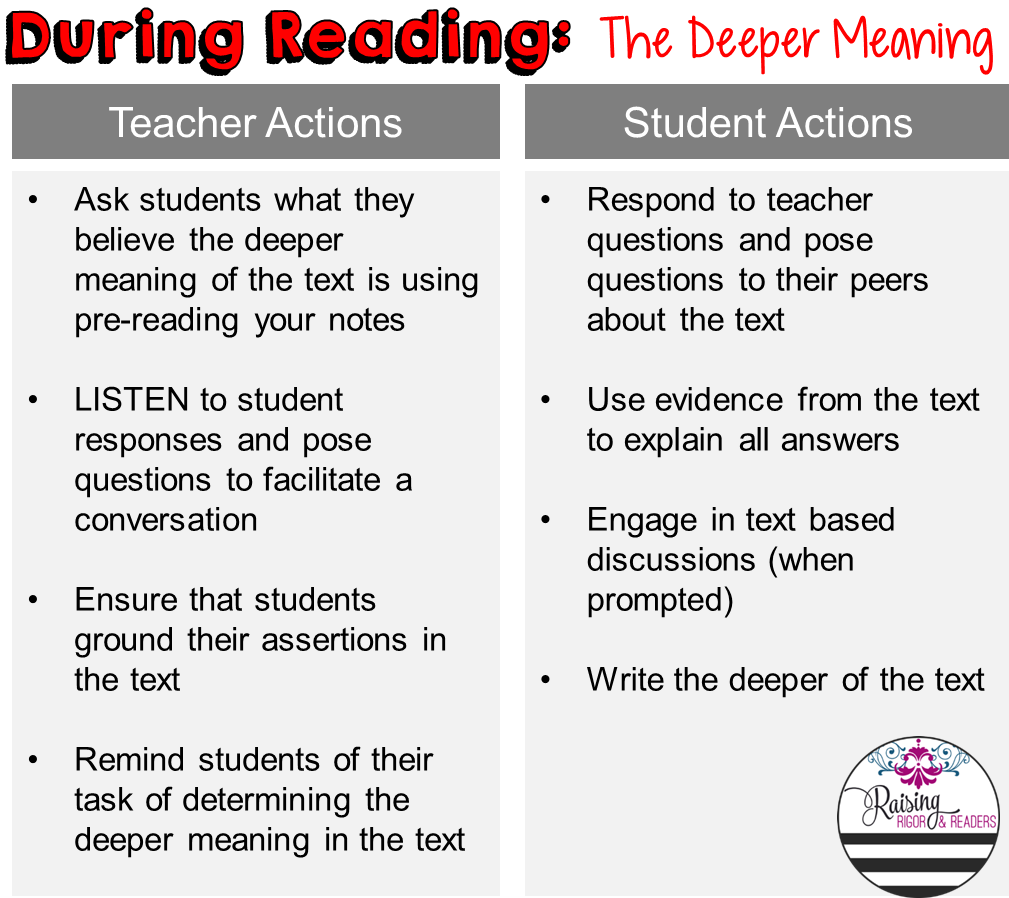
As students demonstrate an understanding of the literal meaning of the text, move forward with the “meat and potatoes” which is the deeper meaning. A pitfall to avoid is spending too much time on the literal meaning of the text. I’ve fallen into this pit by trying to ensure that students understand every little part of the text, and this takes away from the pacing of the lesson and may disengage students. In the sample text that I am using in this post, there are a number of words (i.e. pantaloons, pard, capon) that are not critical in terms of students understanding the larger theme or deeper meaning within the text. Therefore, once students state the big ideas and concepts, I move the class forward in order to focus on the richer themes. This doesn’t mean that students skip over parts of the text, which is contrary to the point of close reading. That said, I move the class forward recognizing that we will reread the text and push our analysis in a manner that bridges gaps for students.
Engaging in conversations around the deeper meaning of the text in a non-leading way is challenging. PERIOD. That said, the most important role that teachers play when engaging with students around the deeper meaning of the text is that of a LISTENER. Teachers must listen and respond to what students are saying and use their expertise of the text to guide student thinking. This underscores the importance of teachers being an expert of the text.
As a final note, when I think about close reading,it’s all about student thinking and analysis. In my humble opinion there is not a “no prep’ way to do it. Teacher knowledge of the the text allows for clarification of misunderstandings and for teachers to guide students through and to the deeper meaning. The lesson I am sharing is focused on students annotating and engaging in a robust conversation about the text. That said, there are times when using a different approach with different tasks is appropriate. For example, teachers may have students write responses to multiple text dependent questions during a lesson, or complete a graphic organizer. This lesson that I am sharing was completed in a small group (8-10) in order to ensure that every student was contributing.The resources for this lesson are {here} for teachers who would like to complete it with their students. Enjoy!
I just moved from Florida to Connecticut and am (kinda) looking forward to a real winter for the first time in my 30-something year old life! With winter comes the opportunity for winter themed activities! I teach at a school where we can say everything except for Christmas! This resource is full “of winter” (and…
Teaching is difficult, but meaningful work. If I am honest, some day THE STRUGGLE IS REAL. Too real. Don’t get me wrong, I love what I do, but have to remain focused on my WHY. Below are my daily affirmations, which keep me grounded. PRINTABLES Now that I’ve shared mine, what are some of yours?…
If the structure does not permit dialogue the structure must be changed. Paulo Freire Tweet Education is about the cycle of learning, revising, challenging, accepting, refuting, and reimagining. Discourse allows students to deepen their understanding of the texts’ ideas and values while strengthening their oral and written argumentation and active listening skills. It enables the…
Winner! The title captured my attention, and the story captured my heart. Readers experience the coming of age of the author, and the complexities of growing up between the Jim Crow south and hope in New York. The poetic form gives snippets into Woodson’s childhood and journey as an emerging writer. The book is divided into…
Poetry is many things. It is: • an art form • a creative expression of emotions and feelings • a layered form of communication • FREEDOM As an ELA or social studies teacher, there are a number of ways to leverage poetry to delve into complex topics. One way I do this, is by making…
Moving from Performance Updates to Partnership Parent-teacher conferences are often seen as a mandated and routine checkpoint —a quick exchange of grades, behavior notes, and next steps. But when done right, they can become something far more powerful: a moment of partnership. As both an educator and a parent, I’ve seen how conferences can either…
We use cookies on our website to give you the most relevant experience by remembering your preferences and repeat visits. By clicking “Accept”, you consent to the use of ALL the cookies.
This website uses cookies to improve your experience while you navigate through the website. Out of these cookies, the cookies that are categorized as necessary are stored on your browser as they are essential for the working of basic functionalities of the website. We also use third-party cookies that help us analyze and understand how you use this website. These cookies will be stored in your browser only with your consent. You also have the option to opt-out of these cookies. But opting out of some of these cookies may have an effect on your browsing experience.
Necessary cookies are absolutely essential for the website to function properly. This category only includes cookies that ensures basic functionalities and security features of the website. These cookies do not store any personal information.
Any cookies that may not be particularly necessary for the website to function and is used specifically to collect user personal data via analytics, ads, other embedded contents are termed as non-necessary cookies. It is mandatory to procure user consent prior to running these cookies on your website.